Wednesday, November 28, 2007

Luxury Fever (review)

© 2000, Coert Visser

This fascinating book describes how a new virus, the luxury fever has Americans seemingly inescapably in its grip: people spend a larger and larger proportion of our money on luxury goods. And, because for most people incomes have remained static or have even declined (in the US and the UK), this extra spending was financed by lower savings and higher debts, making the economy weaker and more vulnerable.


Further, most people work longer and tend to spend less time on important activities such as vacations, being with family, sleeping exercising, etc. To make things worse: Americans spend less on vital public services which leads to a deteriorating infrastructure, to higher crime, to dirty streets and parks, to water pollution, to a deteriorating education system, etc.

And what about health? 40 million Americans currently lack health insurance.... This book explains how there is a competition 1) between different forms of private spending (do we buy luxury or do we spend our money differently?) and 2) between private and public spending. To expand on the latter point: a growing share of the US national income is spent on consumption and spending on vital publics services is increasingly threatened.

Frank explains (on the basis of well-being research and the adaptation-level theory) that the main reason we buy luxury goods is to demonstrate to others that we can afford to thereby trying to distinguish ourselves from them. In doing so we try to achieve happiness by improving our relative status.

The irony is, however, this absolutely doesn't work! The satisfaction we get from luxury spending, which Frank calls conspicuous spending, depends largely on context. The satisfaction we get from luxury spending lasts only shortly.

Two examples:
  1. If we buy an expensive car, this distinguishes us from our neighbour and we feel happy. If, however, next month our neighbour buys an even fancier one, our satisfaction will be largely gone. You can see how this leads to an escalation, an arms race, with no winners.
  2. The satisfaction we get from luxury goods tends to decline steeply over time. We tend to get used quickly to what we have and the favourable features of the luxury good tend to fade into the background rapidly: we no longer notice the fancy features of our expensive car and our satisfaction diminishes.

Bottom line: this increasing conspicuous spending does more harm than good. We have to discourage conspicuous consumption in favour of inconspicuous consumption. Frank explains that no individual or family alone can solve this problem. It has to be solved at a higher level. He proposes a simple but effective measure to discourage conspicuous consumption, a progressive consumption tax levied on consumption rather than income. Frank claims this tax can stimulate radical changes in the ways we lead our lives. Contrary to the believe of many, he convincingly argues, this progressive consumption tax would not cripple the economy but invigorate it. A fascinating book also highly relevant for European countries I think.

Wednesday, November 14, 2007

The Goals Continuum

Helping, negotiating, directing

© 2006, Coert Visser and Gwenda Schlundt Bodien

The goals continuum is a model reflecting in which situation you can apply which skill. The extreme left of the continuum describes situations in which the goals of the employee are the center of the discussion. In these situations helping (coaching) is the most suitable approach. The extreme right is about situations in which the goals of the manager are central. Between the two extremes on this continuum are situations that require negotiation.

Managing people is not always an easy thing to do. Take a look at this example:
A manager told us recently: “One of the people in my team, Bert, does not perform well. Time and again he does not meet the deadlines. As a consequence the delivery to our customers is frequently delayed. This has to stop! But no matter how much I try to help him, I can’t seem to get through to him. He gets irritated, he tries to avoid me and he dismisses my suggestions. What am I to do?”

Use the right skills in the right situation
In order to constructively achieve your goals as a manager it is important to apply the right skills at the right time. In the above example this did not happen. The manager tries to solve a problem by helping the employee. However, directing the employee is in order in the above example. Therefore, helping or coaching does not work. It seems like the manager and the subordinate are on a different wave length which causes nothing to change.

The goals continuum
The goals continuum is a model which describes which skills to apply in which circumstances. The extreme left of the continuum describes situations in which the goals of the employee are prevails. In these situations, helping (coaching) is the most suitable approach. The extreme right represent situations in which the goals of the manager prevail. Between the two extremes on this continuum are situations that require negotiation. The figure below represents the continuum.


1. Extreme left of the continuum: Helping
On the extreme left of the continuum, the goals of the employee are leading. This is the case when the manager does not feel the need to change the behavior of the employee. In these situations, the employee wants to change something and the manager is all right with these changes and goals. This can be the case for example when the employee is performing well and is looking for new work challenges. Another example is a situation in which an employee is performing well at work and asks his manager for help regarding a personal problem. In help-requiring situations, the manager can use the solution-focused approach about which we have written several articles (see here, here, here and here).

2. Extreme right of the continuum: Directing
On the extreme right of the continuum, the goals of the manager (and the organization) prevail. The right side of the continuum describes situations in which the manager wants to change something in the behavior of the employee. This can involve two kinds of change:
  1. Imposing limits / correcting: when the employee’s behavior is unacceptable because it is harmful to others or to the organization, it is necessary for the manager to draw boundaries and clarify to the employee that the particular behavior has to stop and change.
  2. Clarifying performance expectations: when the employee does not show the minimally required performance, and the manager has to take action to stimulate the employee to perform up to standard.
As a manager it is to be recommended you prepare your conversation with an employee properly. In your preparation you can come up with answers (preferably in writing) to the following questions:
  1. What do I want the employee to do differently? What does he have to start doing or what does he have to stop doing?
  2. To what end do I expect this of him? What are the advantages of what I expect him to do? To whom and from what perspective are these behaviors useful?
Also, it is useful to ponder the following questions: Do I have a mandate to direct the employee in this way? What exactly is my mandate? Do I have the authority to ask this? When it becomes clear that you can’t answer these questions affirmatively maybe it is better to check this first with your manager. If you find out that you don’t have the required authority you can try to enlarge your mandate by starting a discussion about the topic with your colleagues or superiors.

In the conversation itself you can provide direction in a solution-focused way by being clear and friendly at the same time. You can be both firm and inviting by using questions while you lead. A format for questions which often work well is:
  1. How can you ensure that …… (what you expect from the employee)
  2. so that …… (the advantage of the behavior you expect)
In this article you can read more about how to do this and also about how you can respond to different ways in which employees might respond to your attempt to direct them. The interesting thing about this way of directing is that an authoritative or bossy tone can almost always be avoided - making it much less likely that employees will resist your attempt to direct them.

3. Middle part of the continuum: Negotiating
In the center of the continuum, between Helping and Directing, there is negotiating. The center of the continuum describes situations in which the manager has goals and wants to exercise some influence. But you realize it is not an all or nothing situation. You are prepared to give and take a bit with respect to the moment in which the change has to be realized and in the amount of change that has to be made. You may want to use an “if you do this, I’ll do that” approach.

Preparation is also very useful when you want to negotiate. Questions that can be helpful are: What goals do you minimally want to achieve? What is your negotiating space? What do the both of you agree on?

Experiences
We have trained many managers to use the Goals Continuum. In a group of managers in a large hospital many of them were satisfied with the model because it helped them to prepare much better for difficult conversations. It also helped them to approach the conversations with employees with confidence. In another organization, we trained all management-levels in this solution-focused approach. The advantage they experience is felt both on an individual level and on a group level. They are pleased to have found a shared way of managing people which helps them to achieve their goals more easily and which the employees generally find pleasant.

We end this article with an example on the right side of the continuum


Steve, a manager in a factory department, had to engage in a difficult conversation with Richard, an employee who had several times shown intimidating behavior towards his colleagues. A few colleagues had already said they were afraid of him. Steve had once before said to Richard that he would not accept physically aggressive behavior. Richard had responded evasively and had said:”It is very hard for me to control my temper because I was mistreated as a child myself”. This conversation between Steve and Richard did not lead to a clear understanding and agreement. Recently, there had been a new situation of Richard intimidating a co-worker and Steve wanted to talk about it with him. This time, Steve had prepared well for the conversation. He had written down what he expected of Richard and why. In the conversation he said: “Richard, you are a much appreciated person in this department because of your commitment and your readiness to help others. No wonder we would very much like to keep you around. For that, it will be necessary for you to restrain yourself at all times when you feel angry so that your colleagues can feel safe around you at all times. How can you that care of this?” After a few seconds, Richard responded like this: “I understand you ask this of me but it is very hard for me to control my anger when I feel challenged. Steve responded understandingly but firmly “I can imagine that after what you have told me recently. And given that is hard for you …. How can you still take care of it so that people will feel safe and we can keep on employing you here?” During the conversation Steve kept on coming back to the HOW-question. The conversation proceeded constructively and Richard and Steve made an agreement that Richard would at all times control himself when angry. Richard has since found a way to do this.

Tuesday, November 13, 2007

The Not-Knowing Posture

© 2006, Coert Visser and Insoo Kim Berg


This article presents some thoughts about the not-knowing posture. Is it easy? Is it valuable? Is it ethical to charge money for your services while assuming a not-knowing posture? Does the not-knowing posture mean you have to completely discard expertise?
Many who are new to the Solution-Focused practice principles seem to get confused by the concept taking a “not-knowing” posture when facing their clients. The not-knowing posture (Anderson and Goolishian, 1992) means that as practitioners we work from the assumption that each case is different. Therefore we do not know exactly what the situation of the client is and what he should think or do. This is why in order to arrive at a more satisfying outcome, solution-focused practitioners ask lots of what seem like strange questions that activate their minds.

We did not realize for a long time that the “not-knowing posture” was creating some confusion among the newly learning therapists, coaches, consultants, trainers, educators and managers. Several questions are raised by confusion.
  1. Does “not-knowing” imply that it’s easy and that anyone can do this work without training and a solid grasp of the philosophy behind it?
  2. If we take a “not-knowing” posture, how can we ethically charge money for our services?
  3. How can I prove to our clients how valuable my service is to them if I don’t know?
  4. I went through years of education and post-graduate training in order to be an expert and now you are saying I should forget everything I learned?
These are some of the most pressing questions we have come across. Let’s have a look and each of these important questions.
Is it easy?
The phrase ‘not-knowing posture’ might suggest that this is very easy to do and that anyone can do this without much effort. Quite the opposite is true. Taking a not-knowing posture is much more difficult than it might seem, because it seems counter-intuitive at first glance. Both as professionals and human beings we have all kinds of experiences, views and opinions. Actively setting these ideas, knowledge, and skills aside by assuming a “not-knowing” posture is demanding and requires great discipline. Furthermore, applying the solution-building model is a specific expertise in itself. We are not expert in knowing what caused the client’s problem and what he or she should do to solve it. Instead, we are experts on “solution-building conversation,” a process by which clients discover their own most effective ways of achieving their goals. Again, this is not easy: It requires both attention and skills that are quire different from problem analysis.
Is it ethical to charge money for it?
The mere fact that taking a “not-knowing posture” is hard, is not enough justification in itself to charge money for it. Taking a not-knowing posture engages clients in their own solution-building process, thus reading his/her goals much quicker, and with confidence. There is an important difference between telling clients what they should do and helping them to find out for themselves what they should do, instead, clients discover what works for them. Traditional tell-sell approaches to coaching and consultancy are wide-spread but can be problematic. Clients might wonder whether the solution offered by the expert will work in his specific situation. Also, they may wonder whether they will be able to execute the solution effectively without spending additional time and expense. Since the solution-focused approach builds on what has already worked for clients it will therefore not create resistance but energy and confidence. This is probably the main reason why the solution-focused approach works well and efficiently (Gingerich & Eisenhart, 2000; Visser & Butter, 2006). This efficiency and effectiveness adds value for the client.
How will clients accept the not-knowing posture?
Taking a not-knowing posture is demanding and valuable but how will clients be able to recognize and understand this? After all, clients may expect you as a consultant, coach or therapist to tell them what to do and think. So, what will they think of you when you will instead start asking a lot of questions? From our careful observations of client response to our thoughtful questions many clients report how our questions are because they help them to form goals and discover strengths, they usually find this very helpful. There is nothing like a personal experience to discover the benefits of the “not-knowing” posture as be activated and energized to make further progress.
For example, a colleague of ours, Steve Langer was interviewed for a job as a consultant for a prison population. The Director of the prison who interviewed him asked him many questions, and Steve found himself describing what he might do as a consultant to difficult prisoners who are hostile, angry, and uncooperative. Instead of continuing to explain to the Director, he said to the director, he knows his prison population very well and would he mind playing one of the difficult prison that Steve might work with. The Director took on the challenge and played a very tough prisoner who was causing a great deal of difficulty for the staff. Of course Steve used all the solution-building practices and took the “not-knowing” posture and asked many questions. The Director was so impressed with Steve that he got hired immediately on the spot.
Some clients may be confused, however. After all, they may have some experiences with other professionals which use a quite different approach. Sometimes it may be helpful to explain it. A manager who was talking with her coach, suddenly smiled and asked: “You do ask a lot of questions, don’t you?” The coach replied: “That’s right, it helps me to understand your situation better.” The manager responded: “Okay, I did not quite expect that but I think it’s very useful.” On another occasion a client explicitly asked for tips from his coach. The coach replied by answering: “Alright, I will give you some tips. Is it alright if I first ask some questions so that I can focus my tips on your specific situation?” The client said: “Of course, you first need to know more about my situation, I understand. I can see that you are very careful with your suggestions, and I like that.”
What about my expertise?
The not-knowing posture does not mean that you know nothing and that you have no expertise. Being able to conduct a solution-focused conversation requires expertise in itself, in addition to others you have, and keep all the other skills you have acquired over the years and continue to learn. While continuing to engage in solution-building conversations, you take a “not-knowing” posture and you postpone your judgments for a while and approach the client’s situation with great curiosity. Many experienced practitioners find time and again that their curiosity has been more than rewarded. One reason for this is that the client will feel he’s taken very seriously and respect for their own expertise. Another reason is that it will create a conversation in which client and solution-focused practitioner will be able to find tailor-made solutions that will fit perfectly to the situation.
We are not alone in arguing for a not-knowing posture when helping clients. Peter Drucker, the famous management guru, once said: “My greatest strength as a consultant is to be ignorant and ask a few questions."
References
  1. Anderson, H. (1990) Then and now: From knowing to not-knowing. Contemporary Family Therapy Journal. 12:193-198.

  2. Anderson, H. & Goolishian, H. (1992) The client is the expert: A not-knowing approach to therapy. In. S. McNamee & K. Gergen (Eds.). Social Construction and the Therapeutic Process. Newbury Park, CA: Sage.

  3. Berg, I.K. & Dolan, Y. (2001). Tales of Solutions. WW. Norton & Company, Inc., New York

  4. Gingerich WJ, Eisengart S: Solution-focused brief therapy: A review of the outcome research. Family Process 39:477-498, 2000

  5. Visser, C.F. & Butter, R. (2006). What works in coaching and consultancy? www.m-cc.nl/solution-focusedchange.htm

Saturday, November 10, 2007

Organizational Resilience in Times of Crisis

Does the people centered management philosophy still work during crisis?

© 2005, Coert Visser

Summary - Researchers like Kim Cameron and Wayne Cascio have said for years that a strategy of laying-off people in many cases does not work, and may even backfire, in times of crisis. The situation in the American airline industry after the terrorist attacks of 9/11 was an almost unparalleled crisis. An excellent chance to take the test. Which companies proved to be most resilient and why?

“We are willing to suffer some damage, even to our stock price, to protect the jobs of our people.”
- Jim Parker, CEO of Southwest Airlines”, 8 OCTOBER, 2001


Crisis in the airline industry
Since 9/11 terrorist attacks, the world economy has suffered severely. The airline industry is one of the worst hit sectors. Passenger numbers fell back drastically, companies showed huge losses, and stock prices fell. Large numbers of employees lost their jobs. These traumatic events have confronted the sector with an ultimate test and have provided organizational scientists with a unique natural experiment. What different strategies have companies followed to handle this crisis and which strategies have proven most effective? These are the questions that researchers Jody Hoffer Gittell, Kim Cameron and Sandy Lim (2005) have formulated and answered.

What does research say on the use of downsizing?
For anyone who has followed the management literature of the last 20 years, this is an exciting study. Researchers like Kim Cameron (Cameron & Whetten, 1987; Cameron, 1994, Cameron, 1998) and Wayne Cascio (Cascio, Young & Morris, 1997; Cascio, 2002) have researched the effects of downsizing for many years. The central questions they have addressed were: does laying off personnel lead to a quick and lasting improvement of the financial position of companies? In brief, the conclusion of their research is: companies that use downsizing are not more profitable than companies who don’t downsize and often hurt themselves in the long term. As a result of the negative impact on relationships downsizings usually negatively impact organizational performance. Furthermore, starting a downsizing scenario often leads to repeated downsizings in the future.

But does this also apply in situations of crisis? Can lay-offs be avoided in these circumstances? Is that realistic? A majority of managers tend to see downsizing as a logical, useful and unavoidable tool in times of crisis. However, research by Kim Cameron (1998) shows that most of these companies are confronted with declining profits, product and service quality, and innovation and a deteriorating organization climate. Based on research findings, Cascio (2002) argues that it pays off to use lay-offs only as a last resort, even in a crisis situation. Is this statement confirmed in the airline industry crisis since 9/11?

How did Southwest Airlines stand the test?
One of the companies with an explicit no-lay-offs strategy is Southwest Airlines. This company has been described in many management books as an example of a company which has achieved extremely good financial results while advocating a very people-centered management philosophy which is very consistently implemented. Herbert Kelleher (see picture), the previous CEO of Southwest once made the following comment which summarizes the Southwest philosophy (O'Reilly & Pfeffer, 2000):

"Who comes first, the employee, customers, or shareholders? That’s never been an issue to me. The employees come first. If they’re happy satisfied, dedicated, and energetic, they’ll take real good care of the customers. When the customers are happy, they come back. And that makes the shareholders happy."

It is wonderful to read how Southwest Airlines has flourished in the good times before 9/111. But how did this company perform during the extremely tough times after 9/11? Did it have to own up and start laying off personnel? How did Southwest Airlines do compared to competitors in these challenging times? Below is a summary of the study by Gittell, Cameron, and Lim.

The research by Gittell, Cameron, and Lim
In the three years that followed 9/11, the researchers studied the ten largest U.S. airline companies: Alaska, American, American Trans Air, America West, Continental, Delta, Northwest, Southwest, United and US Airways. The most important variables they looked at were:

  1. financial reserve: a) low debt position, b) high cash position
  2. percentage lay-offs
  3. recovery of stock prize
The researchers were particularly interested in finding out how relational and financial reserves could account for resilience. Based on the above described research by Cameron, Cascio and others the researchers hypothesized that a strategy of commitment to personnel, in which lay-offs would be seen as a last resort, would create relational reserves and would therefore contribute to a quick recovery. Financial reserves were defined as a low debt position and large amounts of cash on hand. The expectation was that strong financial reserves would muffle the blow of a crisis and that strong financial reserves would thus be associated with resilience. In other words, financial reserves would make it easier to realize a strategy of commitment to employees.

The results fitted the expectations perfectly. Financial reserves coupled with a strong commitment to employees turned out to be strongly associated with organizational resilience. In other words, the higher the financial reserves and the lower the percentage of lay-offs, the quicker the stock price recovered. I made the following table to illustrate the most important results. It ranks the companies on the most important variables (click to enlarge).


Conclusion
It is crystal clear: Southwest Airlines has stood the test brilliantly. Thanks to its excellent performance in the past it has built strong financial reserves. Isn’t it ironic? Analysts had often criticized Southwest for keeping these strong reserves saying they should have been used for acquiring other companies. But this crisis showed that the financial reserves played a crucial helping role. Southwest Airlines did not have to lay off any personnel. Because of this, the company could stick in word and deed to its strong commitment to personnel. Employees understood this message very well. All kinds of negative side–effects of downsizing could be avoided and the Southwest Airlines stock recovered faster than any of the competitors' stocks. Furthermore, Southwest was the only American airline company to make a profit in every single quarter of the period studied, while US Airways, which followed an almost completely opposite strategy (see table) showed a loss in every single quarter.

An airline analyst remarked the following about Southwest: “They are doing what they do best, which is to shine in the hours of trouble.”
1 In 1998 Jeffrey Pfeffer notes: "Southwest Airlines produced a stock market return of over 21,000 percent between 1972 and 1992 and has been profitable in each of the past twenty-four years, a record unmatched by any other airline in the world except Singapore Airlines." Further, he notes that Southwest has the lowest costs and the lowest fares in the American Airline industry. Pfeffer describes the people-centered management practices of Southwest as follows: "Southwest emphasizes training, selective recruiting, profit sharing and stock ownership and has never had a layoff or furlough in its history - all elements of high commitment work systems."
References
  1. Cameron, K.S. & D.A. Whetten (1987). Organizational effects of decline and turbilence. Administrative Science Quarterly, 32: 222-240.
  2. Cameron, K.S. (1994). Strategies for successful organizational downsizing. Human Resource Management Journal, 33: 189-212.
  3. Cameron, K.S. (1998). “Strategic organizational downsizing: An extreme case.” Research in Organizational Behavior, 20: 185-229.
  4. Cascio, W.F., Young, C.E. & Morris, J. (1997). financial consequences of employment change decisions in major US corporations. Academy of Management Journal, 40. 1175-1189.
  5. Cascio, W.F. (2002). Responsible restructuring: Creative and Profitable Alternatives to Layoffs. Berrett-Koehler Publishers
  6. Conlin, M. (2001). Where Layoffs Are a Last Resort. Treating them as unthinkable can have big benefits. BusinessWeek online, October, 2001
  7. Gittell, J., Cameron, K. & Lim, S. (2005). Relationships, Layoffs, and organizational Resilience: Airline Industry Responses to September 11th. Berrett-Koehler Publishers.
  8. O'Reilly, C. & Peffer, J. (2000). Hidden Value. How great companies achieve ordinary results with ordinary people. Harvard Business School Press
  9. Peffer, J. (1998). The Human Equation. Building profits by putting people first. Harvard Business School Press

Thursday, November 8, 2007

Constructive and Activating Management Techniques

© 2005, Coert Visser and Gwenda Schlundt Bodien

Managers frequently say that directing people can be a challenging task. There can be hard situations in conversations when managers try to direct people. What should you do when an employee reacts defensively and does not acknowledge the point you are trying to make? Or what about an employee who raises all kinds of different subjects and one who complains utterly? This article describes a tool for leading in a constructive and activating manner and for dealing effectively with different kinds of responses by employees.


You are a sales manager responsible for leading a team of salespeople. Mike is a senior salesman with outspoken opinions which he is not shy to share. He does not have a high opinion of Pascal, a junior salesman in the team. Yesterday, there was an incident between Mike and Pascal. Another salesperson has told you that Mike called Pascal a “loser who will never become a good salesman”. The incident is the talk of the day. Pascal has reported sick. This situation is not acceptable to you and you decide to have a talk with Mike.

1. Preparation: What about? What? Why?
You know that this is not a situation which lends itself to a coaching approach. Coaching is a useful approach for helping people solve their problems in cases in which you don’t have an opinion about and a stake in what should happen. In this case you do require a specific outcome and that is why this situation lends itself more for providing direction. Because you notice feeling slightly irritated and you don’t want this conversation to lead to accusations and reproaches you decide to prepare it specifically and constructively. In your preparation you avoid heavy-laden and accusative words while making no concession whatsoever regarding your goal. You phrase this goal as much as you can in terms of desired positive results. By doing that, you maximize the chance the conversation will lead to a positive result. You complete the following sentences:

1. I have noticed that …..
2. How can you accomplish that …… so that …….

Through the first sentence (I have noticed that …) you determine the topic of the conversation (WHAT ABOUT). The first part of the second sentence helps you to make clear WHAT you expect from the employee and the second part helps you to explain WHY you expect this. Through the use of the word ‘how’ you activate the employee to determine the way in which the results will be achieved. You make clear that this is his responsibility. After thinking about it for a minute you write down:

Mike, I have noticed that there is some rumor about an incident between you and Pascal. You appear to have said that Pascal is not suited for his job. To perform well as a team it is necessary that we treat each other respectfully and help each other to achieve good results. How can you ensure that Pascal knows that you respect him and accept him as a colleague, so that the two of you can achieve good results together and contribute to a positive work atmosphere in the team and to good team results?

2. Different types of responses to your direction
Employees can respond in different ways. We distinguish between visitor-typical responses, complainer-typical responses and customer-typical responses (DeJong & Berg, 2001). It is useful to recognize the employee’s type of response so that you can deal with it adequately. Below, the case is elaborated in three ways.

a) Visitor-typical responses are responses in which the employee does not see the usefulness and importance of the conversation with you. In the case of Mike, he would respond in a visitor-typical way when he would say: “What’s the fuss about? Surely, we have better things to do than talk about this kind of trifle?” A good way of responding is:
  • Repeat the nature, the reason and the topic of the conversation
  • Stress the importance: It is important that you … so that ….
  • Activate the employee by repeating: How can you accomplish … so that …
  • Keep on repeating and stressing these elements as long as the employee keeps on responding visitor-typically. Let the power of repetition work for you.
Mike: What’s the fuss about? Surely, we have better things to do than talk about this kind of trifle?
Manager: It is really necessary to talk about it now. It is important that we treat each other respectfully and help each other to achieve good results. How can you make sure that Pascal knows that you respect him and accept him as a colleague, so that the two of you can achieve good results together and contribute to a positive work atmosphere in the team and good team results?

b) Complainer-typical responses are responses in which the employee does see the importance of the conversation and the topic but also complains and/or behaves helpless. Mike would respond complainer-typical when he would say: “Yes, I regret what happened between Pascal and me but he performs so badly that I thought it was time for the truth to be told. He makes so many mistakes!” When confronted with a complainer-typical response it is important to stay patient while sticking to the topic. A good response would be:
  • Show understanding for the perception and the behavior of the employee: Aha, I understand that you …. (You don’t have to agree with what he says!)
  • Activate the employee by repeating: Given that this is the case ……how can you accomplish … so that …
  • Keep on repeating and stressing these elements as long as the employee keeps on responding complainer-typically. Let the power of repetition work for you.
Mike: Yes, I regret what happened between Pascal and me but he performs so badly that I thought it was time for the truth to be told. He makes so many mistakes!
Manager: “Aha, I understand you thought the truth needed to be told because you see Pascal’s mistakes. I can imagine this makes it bit harder to stay respectful. Given that this is so, how can you ensure that Pascal knows that you respect him and accept him as a colleague, so that the two of you can achieve good results together and contribute to a positive work atmosphere in the team and good team results?

c) Customer-typical responses are responses which show the employee sees the importance of the conversation and the topic and wants to live up to the expectations. Mike’s response would be customer-typical when he would say: “Yes, I did not treat him with due respect and I should change that. But he gets on my nerves so much that I don’t know how to control myself. Do you have any tips?” A good way of responding is to start coaching. Mike acknowledges the problem, sees the usefulness and the importance of what you ask of him and asks for your help. To provide help is now the most constructive way of proceeding.

Mike: Yes, I did not treat him with due respect and I should change that. But he gets on my nerves so much that I don’t know how to control myself. Do you have any tips?
Manager: I am glad to hear that you see you did not treat Pascal with due respect and that you want to do something about it. I’d be pleased to help you with that.

When confronted with customer-typical responses, it usually works very well to keep on activating the other person to find his own solutions. It is beyond the scope of this article to describe a complete coaching method. On this site you can find some articles with more information.
Finish the conversation with specific agreements on the results to be accomplished. If you can’t reach that in one conversation, make a new appointment and continue in that conversation until a clear agreement is reached.

Applications and limitations of this approach
The tools in this article can help you to effectively provide direction to employees. We realize this method oversimplifies reality a bit and that management conversations will not always be a piece of cake. This approach can not guarantee success in 100 percent of your difficult conversations. No method can promise that. Many managers, however, have experienced that this approach helps them to lead clearly and constructively and to keep the responsibility for achieving results with the employee. It turns out, clarity and friendliness very often can go hand in hand.

References

Wednesday, November 7, 2007

Circles of Change

© 2005, Arnoud Huibers and Coert Visser
The solution-focused approach has brought forward a simple technique which can help to make meetings about organizational change stimulating and effective.

Organizational change
Organizations, departments, and people in organizations work are practically permanently going through large and small changes. Those changes can encompass structural aspects like a change in the business process, merging departments, implementing systems, or changes in the management structure. They can also be about cultural changes like improving customer satisfaction, improving co-operation, raising productivity, and so forth.

Talking about progress
In large-scale change projects, it is very important to keep communicating about the goals of and the progress in the change process. Our observation is that meetings about organizational change often focus on two topics: 1) what goes wrong? and 2) What will we do about that? When people focus attention on these two questions, the result often disappoints. Participants in the meeting can get discouraged of everything that goes wrong and everything that has yet to be done.

The circle technique
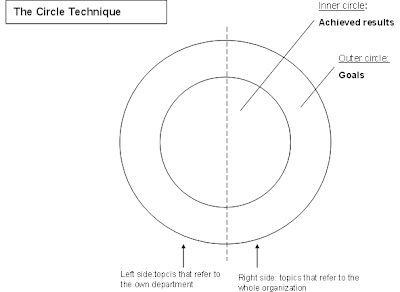
The solution-focused approach to change has brought forward a technique that often helps to make meetings about organizational change simulating: the circle technique. It works like this. The facilitator of the meeting draws two circles on a large board or sheet, an inner circle, and an outer circle. In the inner circle, he writes down everything that has already been achieved and in the outer circle, he writes down what has yet to be achieved. It is also useful to divide the circle in two parts. Topics that refer to the department are written on the left side; topics that refer to the whole organization are written down on the right side (see figure 1).


Way of working
You can apply the circle technique quite broadly and flexibly. You can use it in one-on-one situations, in small groups and in large groups. When applied in small groups a serial approach often works well. The process facilitator asks one person after the other which results have already been achieved and which things have yet to be achieved. In larger groups, a parallel approach might work better. All participants can mention examples of achievements and goals. Splitting up the group into subgroups might also work well. Each subgroup is asked to draw their won circles and write down achievements and goals. Of course, after that, these subgroup circles can be discussed and integrated.

Positive terms
The circle technique works best when the words in the circles are phrased as concrete and positive as possible. In finding the most constructive words, the facilitator plays a crucial role. When participants at first phrase a goal in terms of a complaint (“the managers never gives us feedback”) the facilitator may help them to rephrase this complaint into a goal (“helpful management feedback”). De complaint is rephrased in terms of the presence of something positive instead of in terms of the absence of something.

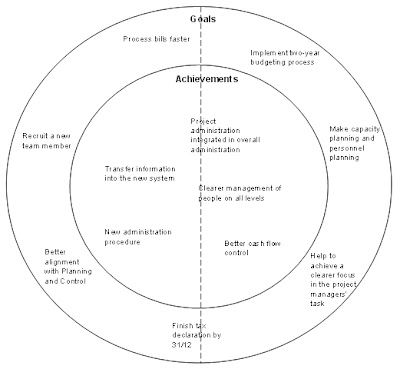
A department manager did the circle exercise together with his team and came to the following achievements and goals (figure 2).


GoalsWhen the circles are filled, the facilitator focuses on the outer circle. First, he asks participants to prioritize the goals mentioned. Often it is wise to limit the number of goals to two or three. Then some attention may be paid to how the goals may be achieved. For this, the scaling technique may be used. More information about this technique can be found here.

AdvantagesUsing the circle technique has several advantages. First, it is very simple and goal oriented. It forces people to focus on the essence: making progress in the desired direction. Secondly, we often notice how participants in meetings are positively surprised by what everything that has already been achieved. This strengthens their confidence, pride and faith. Thirdly, it is very pleasant that people leave the room with some very concrete goals.

Using the circle technique can provide a useful impulse in the change process. We hope you like it and try it out. When you try it, do let us know how it worked!

Looking at the Other Side of the Coin

© 2005, Insoo Kim Berg and Coert Visser

When we, as managers, change how we view a person, we can generate much simpler and easier solutions to them so that we can focus our attention on more difficult and time consuming issues.

Managing people takes more than clear black and white views. Even though it certainly is important to make expectations and rules of conduct clear, it is not as simple as it is described in textbooks. Many good managers have discovered that managing people is an art rather than a science, and all artistic skills take time to develop and become good at. Many competent managers discover this reality by trial and error.


Sometimes this art is described as practice wisdom. By trial and error, good managers have learned that bringing out the best in their workers is the best strategy to motivate, encourage, and teach their workers without “teaching”. Many wise managers have learned that when it is the worker’s idea to change, they will change as much as they can, for as long as they can. On the other hand, when workers are forced to change, they change as little as they can, for as short period as possible.

The most important tool that managers can have is their ability to see both sides of a same coin. Human beings are so complex and multi-faceted that a single, one-dimensional view of a worker is not adequate to describe the whole person, yet we often hear one-sided comments from managers about their workers. “George is unmotivated,” “Linda doesn’t know how to be tactful,” “Mark is a loudmouth,” and so on. It is easy to reduce a worker into a simple description because it saves time and we come to the point.

The problem with this approach is that it does not offer managers better ways to “manage” the difficulty they have with their workers. On the contrary, it reduces the manager’s options. For example, if the problem is one is “unmotivated”, then the logical solution to that is to lecture George about his lack of motivation. You can easily imagine the conversation that might follow which in turn proves to the manager that indeed George is unmotivated. This sets off a chain reaction to “do something about the problem” and leads to further “problem talk” with George. This rarely works in the long run. Pretty soon the manager may find herself repeating the warning, threat, reprimand, and nagging again and again without lasting desired outcome.

On the other hand, suppose the manager saw George as “distracted” instead. One can easily imagine what the manager might do to bring the attention of George back to getting his task done. And reminding and helping George to refocus on his task is much more pleasant for the manager and George than to be nagged at. Seeing George as “unmotivated” may be quite accurate, and so may his being “distracted” and losing his focus be. But framing it in a constructive way offers much more flexible ways to solve the manager’s problem.

The same thing happens with Mark’s “loudmouth” When we label someone as “loudmouth” then our solution to it is to suggest to Mark to be quiet or soft spoken, be more careful when he opens his mouth. It is improbable that Mark will agree with this definition. He is more likely to be defensive and offended, and become angry. Reframing Mark’s behavior as his “outspoken style” will lead to a greater chance to change his tendency to blurt things out. Changing his style is much easier to do than to change his personality. Linda’s lack of tactfulness can be easily viewed as her open and honest style. Again, one can more easily and subtly help them to change the style of communication than offering them communication training.

We believe that most of the time, all of us mean well and generally we just like to be valued and recognized for that. The same goes for George, Mark and Linda. That is why it not so strange they feel hurt and offended when spoken to offensively. It is only understandable they will get defensive. It is only logical that a more constructive approach will make them feel more valued for their good intentions and will make them more open for suggestions and more ready to make some changes.

When we, as managers, change how we view a person, we can generate much simpler and easier solutions to them so that we can focus our attention on more difficult and time consuming issues.